
Affiliate Disclosure:Kid Sitting Safe is reader-supported. When you buy through links on our site, we may earn an affiliate commission at no additional cost to you. This does not influence our reviews or recommendations — we only recommend products we genuinely believe in.
Loading a squirming toddler into a car seat is a daily workout that leaves many parents reaching for ibuprofen. The twisting, stretching, and awkward angles can strain your back, especially in tight parking spaces. Rotating car seats promise to solve this problem by spinning toward the door for easy access. But are they worth the premium price tag?
This guide examines how rotating car seats work, their safety credentials, and whether the convenience justifies the investment for your family.
What Is a Rotating Car Seat?
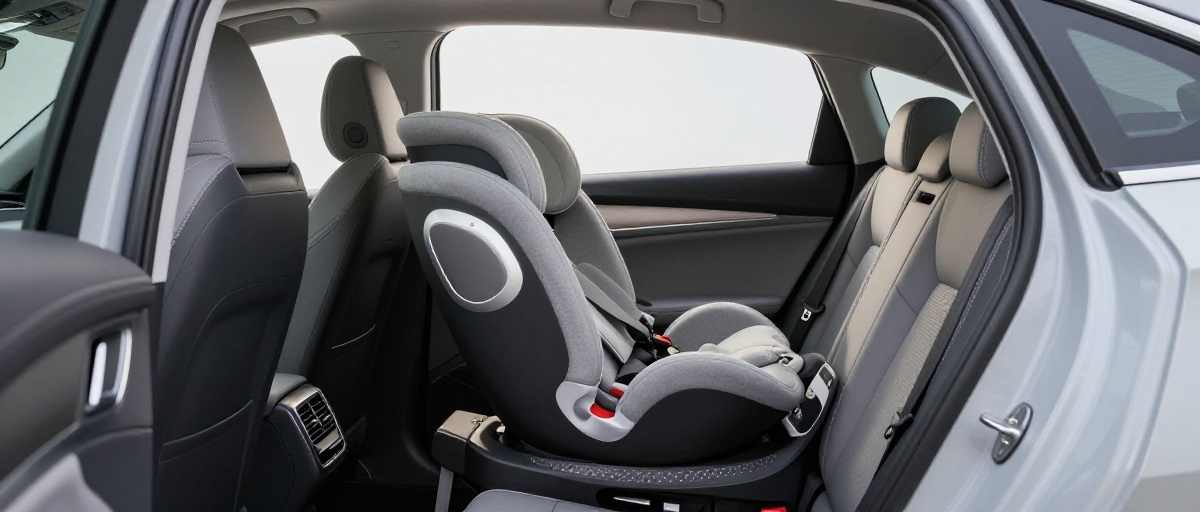
A rotating car seat features a base that stays installed in your vehicle while the seat itself spins 360 degrees. You turn it toward the door when loading or unloading your child, eliminating the need to twist and reach into the back seat.
For driving, the seat locks securely into either rear-facing or forward-facing position depending on your child’s age. When parked, release a mechanism and swivel toward the door.
You’ll also see these called “swivel car seats” or “360 car seats” in marketing materials and parent discussions. The technology has been available in Europe for years but has only recently gained real traction in the US.
One distinction worth making early: true 360-degree rotating seats aren’t the same as Graco’s Turn & Slide technology, which rotates sideways toward the door but doesn’t offer full rotation. We’ll cover that difference in detail later.
All rotating car seats sold in the United States must pass Federal Motor Vehicle Safety Standard (FMVSS) 213 crash testing in their locked positions. The rotation feature is a convenience, not a safety feature, and the seats are held to the same rigorous standards as traditional convertible car seats.
How Rotating Car Seats Work
The mechanics are simple enough. A base installs in your vehicle using either the LATCH system or your vehicle’s seat belt. The car seat attaches to this base and rotates around a central pivot point.
The Rotation Mechanism
Most rotating seats use a button or lever release to unlock the swivel function. Here is the typical process:
- Parking and preparation: Put your vehicle in park and ensure the seat is unlocked for rotation
- Rotate toward door: Press the release mechanism and spin the seat to face the open door
- Load your child: Buckle your child in while the seat faces you
- Lock for travel: Rotate the seat to the appropriate position for driving and confirm it locks in place
- Verify lock status: Most seats have visual or audible indicators showing secure lock engagement
Always lock the seat into either rear-facing or forward-facing position before you drive. You can’t operate the vehicle with the seat rotated sideways toward the door.
Rear-Facing to Forward-Facing Transition
One significant advantage of rotating seats is the ease of transitioning from rear-facing to forward-facing mode. With a traditional convertible seat, you typically need to uninstall the seat, adjust the recline angle, re-route the harness straps, and reinstall it facing forward.
With a rotating seat, you simply adjust the harness height if needed and rotate the seat to the forward-facing position. The base installation remains unchanged. This saves time and reduces the risk of installation errors during the transition.
The LATCH system provides a secure anchor for the base installation. Proper installation is critical regardless of seat type, so take time to review both your vehicle manual and the car seat instructions. For more details on proper installation techniques, see our guide to car seat installation.
Benefits of a Rotating Car Seat
Easier Loading and Unloading
The convenience is genuinely significant. When the seat faces the door, you can buckle your child while standing outside the vehicle rather than leaning in at an awkward angle. Especially helpful for:
- Parents recovering from childbirth or C-sections
- Caregivers with back problems or limited mobility
- Tight parking spaces where opening the door fully is impossible
- Three-door vehicles with limited back-seat access
Reduced Physical Strain
Twisting to load a child into a traditional car seat takes a genuine toll over time. Paediatricians and occupational therapists frequently cite car seat loading as a source of back strain for parents of infants and toddlers. Rotating seats eliminate this repetitive stress.
And it’s not just parents who benefit. Grandparents and other caregivers with mobility limitations often find rotating seats much more manageable than traditional designs.
Smoother Transition Between Modes
As mentioned earlier, the ability to switch from rear-facing to forward-facing without reinstalling the seat saves time and reduces potential for error. For families who value extended rear-facing, this feature makes it simple to keep children rear-facing longer since there is no installation barrier to switching back if needed.
AAP recommends keeping children rear-facing as long as possible, ideally until they reach the maximum weight or height limit of their car seat. For more on this safety recommendation, see our article on extended rear-facing.
Better for Multi-Vehicle Families
If you frequently move a car seat between vehicles, a rotating seat with a dedicated base in each car can be convenient. The seat clicks into whichever base you need, and the rotation feature makes loading easy regardless of which vehicle you are driving.
This setup requires purchasing additional bases, but it may still cost less than buying multiple complete car seats.
Drawbacks and Considerations
Rotating car seats are not the right choice for every family. Here are the key considerations to weigh.
Higher Price Point
Rotating seats cost significantly more than traditional convertibles. Mechanical complexity adds to manufacturing costs, and you’ll pay a premium compared to non-rotating alternatives in the same quality tier.
That said, if you plan to use the seat for 10 years (as many all-in-one rotating seats allow), per-year cost becomes more reasonable. It depends on how much you’ll actually use the rotation feature and how long you plan to keep the seat.
Bulkier Base Design
Rotating mechanisms require a larger base than traditional seats. That added bulk can be problematic in smaller vehicles or when trying to fit three car seats across a single row.
Drive a compact car or need to fit multiple seats? Check dimensions carefully before purchasing. Our guide to the best car seats for small cars offers alternatives for tight spaces.
Added Mechanical Complexity
More moving parts mean more potential failure points. While rotating seats are tested to the same FMVSS 213 standards as traditional seats, some parents worry about long-term durability of the rotation mechanism.
Good news: the locking mechanism is built to withstand crash forces. If rotation were to wear out over time, the seat would still function safely in its locked position. Do register your seat with the manufacturer, though, to receive any safety recall notifications.
Fewer Model Choices
The rotating seat market is still relatively small compared to traditional convertible seats. You have fewer options to choose from, which may limit your ability to find the perfect fit for your specific vehicle or child.
Weight and Height Limitations
Some rotating seats have slightly lower weight limits than premium traditional seats. If extended rear-facing is a priority, compare the rear-facing weight limits carefully. The AAP recommends rear-facing as long as possible, so a seat with a higher rear-facing weight limit may be preferable even without the rotation feature.
Best Rotating Car Seats Compared
Evenflo and Cybex led the US rotating market for years, and Chicco have since joined them with the Fit360. Here’s how the top models compare.
| Model | Rear-facing | Forward-facing | Booster | Modes | Standout Feature |
|---|---|---|---|---|---|
| Evenflo Revolve360 Extend | 4-50 lbs, 17-48 in | 30-65 lbs, 35-49 in | 40-120 lbs, to 57 in | 3 | Rear-facing to 50 lb |
| Evenflo Revolve360 Slim | 5-50 lbs, to 48 in | 30-65 lbs, to 49 in | None | 2 | Narrow profile for 3-across |
| Cybex Sirona S 360 | Not verified | Not verified | None | 2 | SensorSafe technology |
| Chicco Fit360 ClearTex | 4-40 lbs, to 43 in | 26.5-65 lbs, to 49 in | None | 2 | LeverLock belt install |
Read that table by column, not by headline. Evenflo advertises the Extend as covering “4 to 120 pounds”, which is true of the seat’s whole life and untrue of any single mode. Rear-facing, it stops at 50 pounds. That’s still excellent, and it’s the actual reason to buy this seat, but it isn’t 120.
Evenflo Revolve360 Extend
Evenflo’s own copy calls this the Gold Revolve360 Extend, and it’s the standout for families who want one seat to do the whole job. It runs three modes: rear-facing, forward-facing with the harness, and high-back booster.
The number that matters is the rear-facing cap of 50 pounds, against 40 on most convertibles. For a typical child that’s another year or more rear-facing, which is what NHTSA and the AAP both recommend maximising. Evenflo backs it with a limited lifetime warranty. It weighs 32.4 pounds, so plan on leaving it installed.
Rotation operates smoothly and locks securely with an audible click. Clear indicators show when it’s properly locked for travel. Installation with LATCH connectors is straightforward, though the base is bulkier than traditional designs.
Best for: Families who want one seat to last a decade and do not mind the larger footprint.
Evenflo Revolve360 Slim
All the benefits of the Revolve360 in a narrower package. The Evenflo Revolve360 Slim is specifically designed for families who need to fit three car seats across a single row.
The slim profile doesn’t sacrifice rotation. You still get the full 360-degree swivel, in a package that works better in tight spaces. One difference from the Extend that the marketing glosses over: the Slim is a 2-in-1, rear-facing and forward-facing only. There’s no booster mode, so it won’t be the last seat you buy.
If you previously ruled out a rotating seat because of space, the Slim may change your calculation. It addresses the biggest complaint about rotating seats, which is bulk.
Best for: Families with multiple children needing three-across seating arrangements.
Cybex Sirona S 360
Cybex’s Sirona S 360 is a premium offering emphasising advanced safety technology. SensorSafe is the headline feature - a smart clip that alerts you if your child unbuckles the harness, if the seat gets too hot or cold, or if your child has been seated too long.
Then there’s the load leg, a metal bar extending from the base to the vehicle floor that reduces rotation forces in a crash. Common in European seats, still rare in the US market.
Weight range of 5-65 lbs is narrower than Evenflo’s offerings, and the Cybex doesn’t convert to a booster seat. But for the infant and toddler years, the safety technology and premium build quality are compelling.
For more options from this manufacturer, see our Cybex car seat reviews.
Best for: Parents who prioritize premium safety features and smart technology integration.
Chicco Fit360 ClearTex
Chicco’s entry into rotating seats, and the one to look at if the daily loading is what’s selling you on the category rather than the mode transition. It rotates a full 360 degrees with one hand, so you turn the shell to face the open door, buckle the child at the opening, then turn it back.
Installation is the other half of the pitch. The LeverLock system is a belt install that works by open, route, close: you open a door on the base, run the vehicle belt through the guides on its natural path, then latch the door and the mechanism takes up the tension for you. It’s Chicco’s answer to Britax’s ClickTight, and it means the tight install doesn’t depend on how hard you can brace and pull.
Check the LATCH limits before you plan around them, because they’re well below the harness limits. Chicco cap the lower anchors at 30 pounds rear-facing and 35 pounds forward-facing, against harness limits of 40 and 65. Neither number is on the marketing copy; both are in the manual and on the label stuck to the side of the seat. In practice most families using LATCH will hit that ceiling partway through the seat’s life and have to redo the installation with the vehicle belt, which is what the LeverLock system is built for anyway.
Two modes, not three. It rear-faces 4 to 40 pounds and forward-faces 26.5 to 65, then it’s done: there’s no booster stage, so a separate booster is still coming. At 33.8 pounds it’s the heaviest seat in this comparison, and the rotating mechanism is most of that, so treat it as install-once. The 15-position headrest is the widest adjustment range Chicco fit to anything, the fabrics are ClearTex with no added flame retardant chemicals, and the seat is GREENGUARD Gold certified. Chicco give it 8 years from manufacture, two more than their KeyFit infant seats.
Worth knowing that the Fit360 is a family rather than a single seat. Chicco also sell a Fit360 SE and a Fit360 Zip, and the SE in particular is a different seat: it starts at 12 pounds rather than 4, so it won’t take a newborn.
Best for: Parents loading a child in and out several times a day, especially in a tight parking space.
How Graco’s Turn & Slide Technology Compares
Graco entered the rotating seat conversation in early 2026 with their Turn & Slide technology. However, Graco’s approach differs from the 360-degree rotating seats discussed above.
Turn & Slide rotates the seat sideways toward the door but does not offer full 360-degree rotation. The seat slides laterally on a track rather than spinning on a central pivot. This is a different engineering solution to the same problem: making it easier to load your child.
As of this writing, Graco offers Turn & Slide on an infant seat rather than a convertible or all-in-one car seat. This limits its lifespan compared to the Evenflo and Cybex options discussed earlier. However, the infant seat application makes sense because loading newborns into rear-facing infant seats involves the most awkward reaching.
For more details on Graco’s rotating seat announcement, see our coverage of Graco launching its first rotating infant car seat.
Recalled, April 2026. NHTSA campaign 26C003000 covers certain SnugRide Turn & Slide infant seats, and Modes Nest travel systems containing them, because the carrier can detach from the base in a crash. That’s a failure to comply with FMVSS 213, and it affects roughly 5,126 seats. Graco is replacing affected seats free of charge, and tells owners to install the carrier with the vehicle seat belt and without the base in the meantime. Owner letters were mailed 22 May 2026.
The bottom line: Turn & Slide is a genuinely different idea from the 360-degree seats in this guide, and on paper it addresses a real ergonomic problem. Given the recall above, though, it isn’t a seat we’d point you at right now. If you want rotation today, the seats covered earlier are the ones with the track record.
Traditional Alternatives Worth Considering
A rotating car seat is not mandatory for safe child transportation. Traditional convertible and all-in-one seats have an excellent safety record, often cost less, and may be a better fit for your situation.
Graco 4Ever DLX
Widely regarded as the best value in traditional all-in-one car seats. The Graco 4Ever DLX spans a similar birth-to-booster range to the Revolve360 Extend, just without rotation. Compare the two on their rear-facing caps rather than their headline ranges, since that’s where all-in-ones differ most and where the Extend’s 50 lb is unusually good.
Both can serve from birth through booster age. Installation is straightforward with Graco’s InRight LATCH system, though you’ll need to reinstall when transitioning from rear-facing to forward-facing.
For a detailed analysis, see our Graco 4Ever DLX review.
Best for: Budget-conscious families who do not need rotation and want proven reliability.
Britax One4Life ClickTight
If installation ease is your priority, the Britax ClickTight system may be more valuable than rotation. The ClickTight mechanism allows you to install the seat using your vehicle’s seat belt with a simple clicking action, achieving tight installation without the LATCH weight limits.
Covering 5-120 lbs across rear-facing, forward-facing, and booster modes, it’s a premium seat at a premium price. But ClickTight installation is genuinely easier than traditional LATCH for many parents.
For a complete analysis, see our Britax One4Life review.
Best for: Parents who prioritize installation ease over loading convenience.
When to Choose Traditional
Consider a traditional convertible or all-in-one seat if:
- You are on a tight budget and cannot justify the rotating seat premium
- You drive a compact car with limited back seat space
- Extended rear-facing with higher weight limits is your top priority
- You prefer simpler mechanics with fewer moving parts
- You already find loading your child manageable without rotation
Traditional seats have been on the market for decades and have an excellent safety track record. For more on the different types available, see our guide to car seat types explained.
Safety Standards for Rotating Car Seats
Rotating car seats are held to the exact same safety standards as every other car seat sold in the United States. They must pass FMVSS 213 testing, which includes:
- Frontal crash testing at 30 mph
- Side-impact testing requirements
- Flammability standards for materials
- Labeling and instruction requirements
NHTSA doesn’t separately regulate the rotation mechanism, but it must function properly during crash testing. The seat can’t unlock or rotate during a simulated crash event.
What This Means for Parents
Rotation is a convenience, not a safety advantage. A rotating car seat isn’t safer than a traditional seat simply because it rotates. Safety depends on:
- Proper installation: The seat must be installed tightly with less than one inch of movement at the belt path
- Correct harness positioning: Straps should be at or below shoulder level for rear-facing, at or above for forward-facing
- Appropriate use for your child’s size: Stay within weight and height limits for each mode
- Secure locking: For rotating seats, always verify the seat is locked before driving
AAP recommends rear-facing as long as possible, ideally until your child reaches the seat’s maximum rear-facing weight or height limit. That recommendation applies regardless of whether your seat rotates. For more on this, see our guide to extended rear-facing.
Lock Indicators Are Essential
When shopping for a rotating seat, prioritize models with clear lock indicators. You should be able to see or hear confirmation that the seat is properly locked in place before you start driving. Most quality rotating seats include visual indicators that change color from red (unlocked) to green (locked).
NHTSA provides resources on car seat safety and proper installation at their official car seat information portal. Always register your car seat with the manufacturer to receive any recall notifications.
Choosing between a rotating car seat and a traditional model comes down to convenience versus cost and space. Rotating seats make loading and unloading significantly easier, especially if you’ve got physical limitations or a challenging vehicle layout. Traditional seats offer proven safety at lower prices with more model options.
Both paths lead to the same destination: keeping your child safe. Pick the seat that fits your child, your vehicle, and your budget - then use it correctly every single ride.
Recommended Products
Evenflo Gold Revolve360
Best overall rotating car seatThe reason to buy this one is the 50 lb rear-facing cap, which buys most children a year or more of extended rear-facing over a 40 lb seat. The rotation is what sells it and the rear-facing range is what matters. Heavy, and it needs the space, so measure before you commit.
What We Like
- Rear-facing all the way to 50 lb, which is 10 to 15 lb beyond most convertibles
- One-hand 360-degree rotation, so you load your child facing the door
- No-rethread harness, and one install covers both rear and forward-facing
- Limited lifetime warranty from Evenflo
- Side impact protection, and SensorSafe on this trim
What We Don't
- 32.4 lb, so it's not a seat you move between cars casually
- The rotation mechanism needs real front-to-back space; check your vehicle first
- Forward-facing minimum is 30 lb, higher than many seats, which is a feature rather than a fault but does affect timing
Evenflo Revolve360 Slim
Best for 3-across seatingRevolutionary design that saves parents' backs while maintaining rigorous safety standards.
What We Like
- 360-degree rotating seat simplifies loading and unloading
- Slim design allows 3-across configuration in most vehicles
- Sure360 Safety Installation System with LockStrong for secure fit
- Rear-facing to 50 pounds, forward-facing to 65 pounds
- Extended rear-facing capability
What We Don't
- Rotation mechanism requires learning curve initially
- Premium pricing for rotating feature
- Heavier than non-rotating convertible seats at 29 lbs
Cybex Sirona S 360
Best premium rotating car seatBest rotating convertible with innovative SensorSafe technology.
What We Like
- 360-degree rotation for easier child loading and unloading
- SensorSafe chest clip technology with smartphone alerts
- Load leg provides anti-rotation protection
- One-hand rotation operation for convenience
What We Don't
- Premium pricing, near the top of the rotating seat tier
- Heavy at 30.8 lbs making installation and transfers difficult
- Requires smartphone for SensorSafe functionality
Chicco Fit360 ClearTex Rotating Convertible Car Seat
Best rotating seat for daily loadingChicco's rotating convertible, and the rotation is the whole argument for it. If you're loading a child into a rear-facing seat several times a day in a tight parking space, turning the shell to the door instead of reaching around it is a genuine daily saving. The trade-offs are weight and the low LATCH ceilings, which push you onto the belt install sooner than the headline limits suggest.
What We Like
- 360 degree one-hand rotation turns the seat to face the door, so you buckle a child at the opening rather than leaning across a rear-facing shell
- LeverLock self-tensioning belt installation works by open-route-close, and tightens the belt as the door latches rather than asking you to brace and pull
- Quick-Secure harness system pairs a magnetic chest clip with a flex-forward buckle, which keeps the straps out of the way while you lower a child in
- 15-position no-rethread headrest, the widest adjustment range Chicco fit to any of their seats
- ClearTex fabrics are made without added flame retardant chemicals, and the seat is GREENGUARD Gold certified for low chemical emissions
- 8-year lifespan from manufacture, two years longer than Chicco's KeyFit infant seats
What We Don't
- Heavy at 33.8 lbs, and the rotating mechanism is most of that, so this is a seat you install once rather than move between cars
- The LATCH limits are well below the harness limits, 30 lbs rear-facing and 35 lbs forward-facing, so most families will have to switch to a belt install partway through the seat's life
- 32.25 inch footprint when rear-facing is demanding in a compact car
- No booster mode, so it is outgrown at 65 lbs and a separate booster is still needed
Cybex Sirona S with SensorSafe
Best smart safety featuresCutting-edge smart seat with full rotation.
What We Like
- 360-degree rotation for easy child access
- Load leg technology for enhanced stability
- SensorSafe 2.0 chest clip with multiple safety alerts
- App connectivity for real-time safety notifications
What We Don't
- Premium pricing, near the top of the rotating seat tier
- Requires smartphone for full SensorSafe functionality
- Heavy and bulky design limits portability
Graco 4Ever DLX
Best non-rotating all-in-one alternativeUltimate budget all-in-one solution for growing families.
What We Like
- 4-in-1 functionality grows with child
- 10-year lifespan from rear-facing to booster
- Simply Safe Adjust harness adjusts from front
- Budget-friendly compared to similar models
What We Don't
- Takes up significant space in vehicle
- Installation requires time and effort to secure properly
Britax One4Life ClickTight
Best non-rotating premium alternativePremium choice for parents prioritizing installation confidence and long-term structural integrity.
What We Like
- ClickTight installation system virtually eliminates user error
- Full steel frame with SafeCell crumple zone for superior crash protection
- 15-position no-rethread harness and headrest for easy adjustments
- 10-year lifespan covers child from infancy through booster stage
What We Don't
- Premium pricing, well above the mainstream all-in-one tier
- Heavy at 30.5 lbs, limiting portability between vehicles
- Bulky footprint may not fit well in smaller vehicles
Sources & Research
- Evenflo official product page, read 2026-08-03. Source for every per-mode limit, the 32.4 lb weight, the no-rethread harness and the limited lifetime warranty. Evenflo's own copy calls it the "Evenflo Gold Revolve360 Extend", which is why this record's name is not a mismatch
- Amazon Product Page
- Amazon Product Page
- Manufacturer Page
- Chicco USA Official Product Page (Fit360 ClearTex, Carbon)
- Chicco Fit360 Car Seat Product Manual (02-2025)
- Amazon Product Page
- Graco Official Product Page
- Amazon listing for the current ASIN, read 2026-08-03. "Britax One4Life All in One Car Seat, Up to 10 Years of Use". IN_STOCK at $439.99, with a colour selector and a One4Life / One4Life Slim style selector
- Britax site search, 2026-08-03. Confirms the current range and pricing. Britax sells this seat as BOTH "One4Life" and "One4Life ClickTight" at $439.99, plus a separate One4Life Slim ($449.99) and a ClickTight Anti-Rebound Bar version ($479.99)
Continue Reading
Explore more convertible car seats content or browse our other categories.
Frequently Asked Questions
- Are rotating car seats as safe as traditional car seats?
- Yes. Rotating car seats sold in the US must pass the same FMVSS 213 crash test standards as every other car seat, and the rotation mechanism locks in both rear-facing and forward-facing positions before driving. That certification is the floor every seat clears, so it isn't a way to tell two rotating seats apart. Evenflo states side impact protection on the Revolve360 Extend; where a manufacturer claims testing beyond the federal standard, check whether they publish the protocol behind it.
- At what age can a child use a rotating car seat?
- Most rotating car seats are convertible seats that work from birth through the toddler and preschool years. The number to look at is the rear-facing cap, not the headline range. Evenflo's Revolve360 Extend spans 4 to 120 pounds overall, but that breaks down as 4 to 50 pounds rear-facing, 30 to 65 pounds forward-facing and 40 to 120 pounds in booster mode. The Cybex Sirona S 360 covers 5 to 65 pounds across rear-facing and forward-facing modes. A single span from 4 to 120 pounds never means a seat rear-faces to 120.
- Do rotating car seats fit in small cars?
- Rotating car seats are generally bulkier than traditional seats because the swivel base adds height and depth. The Evenflo Revolve360 Slim was specifically designed for tighter spaces and supports 3-across seating in many vehicles. Before buying, check the seat's dimensions against your vehicle's back seat measurements.
- How does the Graco Turn and Slide technology compare to full 360-degree rotation?
- Graco's Turn and Slide technology, announced in early 2026, rotates the seat sideways toward the door for easier loading and unloading but is not a full 360-degree swivel. Full-rotation seats like the Evenflo Revolve360 spin completely around, allowing the transition from rear-facing to forward-facing without reinstalling the base.
Written By
Kid Sitting Safe
Our team researches car seat safety standards, crash test data, and real-world usability to help parents make the safest choice.
Related Articles

Best All-in-One Car Seats 2026: Convertibles Compared
All-in-one and convertible car seats compared for 2026. Safety ratings, installation ease, and longevity from infancy through booster age, with picks from Graco, Britax, Chicco and Safety 1st.
Best Rear-Facing Car Seats 2026: Extended Use to 50+ lbs
Rear-facing car seats for 2026 that extend rear-facing use to 50+ lbs. Picks from Nuna, Clek, Graco, Britax and Diono compared on safety, recline positions, install ease, and how long your child can stay rear-facing.
Britax One4Life Review: Premium All-in-One Worth the Price?
Comprehensive Britax One4Life ClickTight review. We break down the premium all-in-one car seat's installation, safety features, and 10-year lifespan. Is it worth the investment?